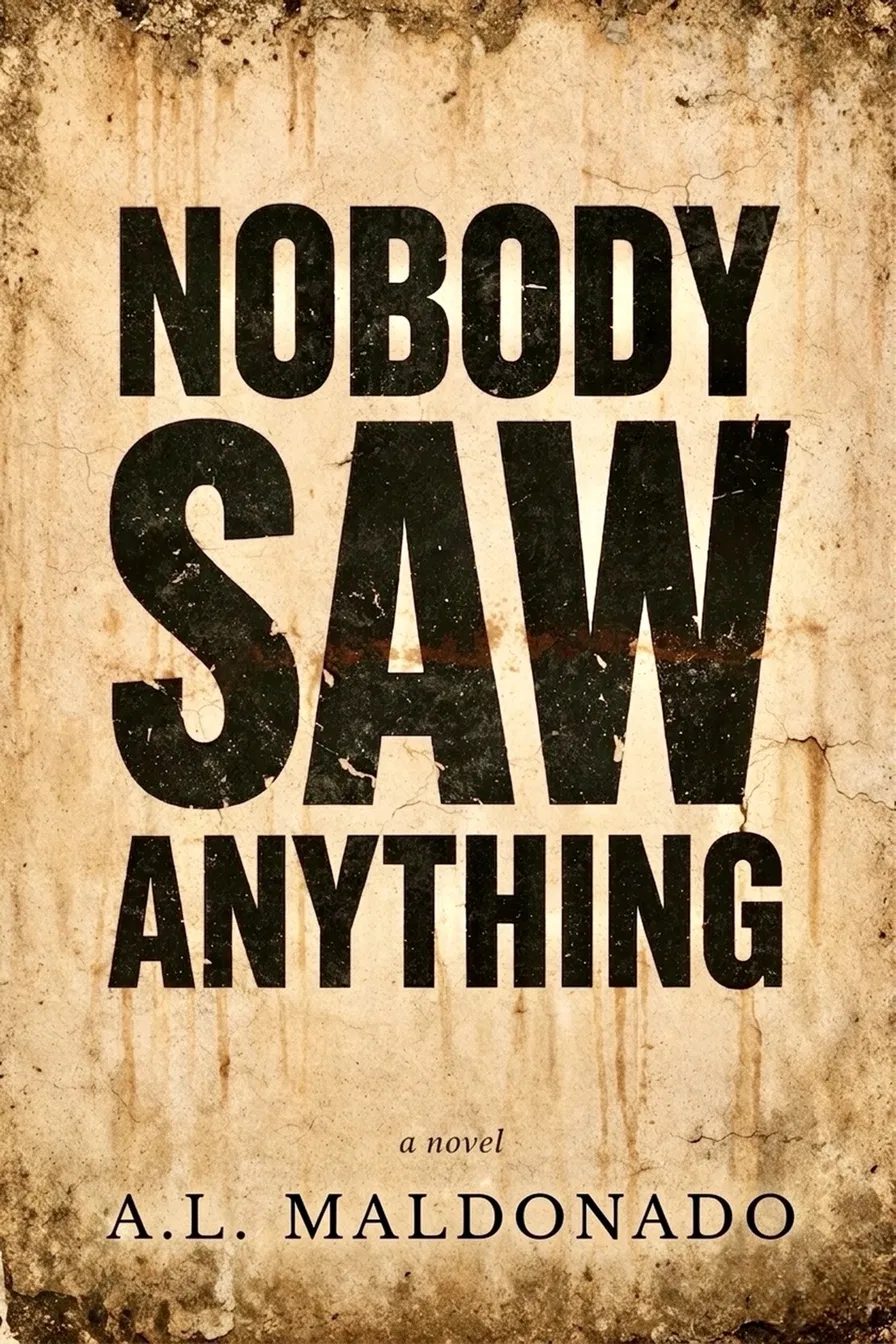
Nobody Saw AnythingNobody Saw Anything
A veces, el hogar no es el lugar al que regresas.Sometimes, home isn't the place you return to.
Marcos Colón dejó Los Claveles a los dieciocho años con una maleta de Pitusa y un billete de ida a Florida. Le prometió a su madre que volvería. Se prometió a sí mismo que no lo haría.
Marcos Colón left Los Claveles at eighteen with a suitcase from Pitusa and a one-way ticket to Florida. He promised his mother he’d come back. He promised himself he wouldn’t.
Veintiséis años después, rompe ambas promesas.
Twenty-six years later, he breaks both promises.
Ponce, Puerto Rico. Un pueblo gobernado durante dieciséis años por un hombre que trata al municipio como si fuera su hacienda particular. Un complejo residencial donde la cancha de baloncesto es un monumento —que nadie construyó— a los niños que se tragaron los edificios. Un lugar donde todos saben todo y nadie vio nada, porque ver algo implica involucrarse, e involucrarse es el único lujo que nadie puede permitirse.
Ponce, Puerto Rico. A town governed for sixteen years by a man who treats the municipality like a personal hacienda. A residencial where the basketball court is a memorial nobody built for the children the buildings consumed. A place where everybody knows everything and nobody saw anything, because seeing something means getting involved, and getting involved is the one luxury nobody can afford.
Marcos tiene los discursos. Tiene el fuego. Cuenta con veinte años de formación política en Tampa y con esa clase de ira que solo llevan consigo quienes se marcharon: una ira teñida de culpa y afilada por la distancia, propia de un hombre que escapó de un lugar que siguió devorando a sus hijos una vez que él se hubo ido.
Marcos has the speeches. He has the fire. He has twenty years of political training from Tampa and the kind of anger that only the people who left carry — the guilt-edged, distance-sharpened anger of a man who escaped a place that kept eating its children after he was gone.
Pero Ponce no es la ciudad que él recuerda. El alcalde corrupto al que vino a desbancar es un adversario más astuto de lo que él esperaba. La gente a la que vino a salvar resulta más difícil de alcanzar de lo que cualquier manual de campaña le había hecho prever. Y el pasado que creyó haber enterrado bajo veintiséis años de distancia y silencio sigue ahí: en el hormigón, en el patio, en los ojos de una mujer que lee libros en las escaleras del Edificio 3 y que ha estado esperando —con la paciencia de quien conoce la diferencia entre lo bueno y lo verdadero— a que Marcos regrese a casa y afronte aquello que no puede resolver mediante el debate.
But Ponce is not the town he remembers. The corrupt mayor he came to unseat is a smarter enemy than he expected. The people he came to save are harder to reach than any campaign playbook prepared him for. And the past he thought he’d buried beneath twenty-six years of distance and silence is still here — in the concrete, in the courtyard, in the eyes of a woman who reads books on the stairs of Building 3 and who has been waiting, with the patience of someone who knows the difference between what is good and what is true, for Marcos to come home and face the one thing he cannot debate his way out of.
"Nobody Saw Anything" transcurre entre la década de 1990 —cuando Marcos era un adolescente que se abría paso en la violenta geografía de los complejos de vivienda pública bajo la política de «Mano Dura contra el Crimen»— y el presente, momento en que una campaña para transformar la ciudad choca con fuerzas que ninguna elección puede controlar. Es una novela sobre el poder y la culpa. Sobre los lugares que nos moldean y el precio de dejarlos atrás. Sobre lo que sucede cuando el chico que huyó regresa convertido en hombre y descubre que aquello de lo que escapaba nunca se marchó.
"Nobody Saw Anything" moves between the 1990s — when Marcos was a teenager navigating the violent geography of public housing under Mano Dura Contra el Crimen — and the present, where a campaign to transform a city collides with forces that no election can control. It is a novel about power and guilt. About the places that shape us and the cost of leaving them. About what happens when the boy who ran comes back as a man and discovers that the thing he was running from never left.
Puedes leer el capítulo completo en una ventana de lectura protegida — pensada solo para leer.
You can read the full chapter in a protected reading window — meant for reading only.
"Nos han pedido guerra y guerra tendrán." — Governor Pedro Rosselló, 1993
"The machine works perfectly. It just doesn’t work for everybody."
A NOTE FROM MY HEART
This book was written in English. I say this not as an apology but as a declaration, because for a Puerto Rican writer who has spent over thirty years writing in Spanish—in the Spanish of the island, the Spanish of the residenciales and the colmados and the balconies where the women watch and the men pretend not to be watched—choosing to write in English is not a simple decision. It is a crossing. Not of language but of self.
I did not translate this novel. I wrote it. There is a difference. A translated book carries the ghost of its original, the phantom limb of the language it was born in, and the reader can feel it— the syntax that bends in unfamiliar directions, the metaphors that arrive from somewhere else, the cadence that belongs to another music. This book has no ghost. It was conceived in English, drafted in English, argued with in English, and finished in English. It breathes in English. But its heart beats in Spanish, because a heart does not change languages. A heart beats in the rhythm it learned first, and my heart learned its rhythm in Ponce, in the concrete corridors of a place that
no longer exists exactly as I remember it but that exists, permanently, in the architecture of who I am.
I want to be clear about something: writing in English does not make me less Puerto Rican. This is a conversation I have had with myself more times than I can count, in the quiet hours when the writing stops and the doubt begins, when the voice in my head—the voice that thinks in Spanish, that dreams in Spanish, that curses in Spanish because the best curses are always in the mother tongue—asks me whether the English sentences I am building are betrayals. Whether the act of rendering the island in the language of the mainland is a surrender. Whether I am, by choosing this vocabulary, by choosing these conjugations, by choosing a grammar that does not carry the weight of ñeta and wepa and bendición in its native structure, committing the one sin that a Boricua writer cannot afford: forgetting where I come from.
I have not forgotten. The proof is in these pages. Every sentence in this novel is a Puerto Rican sentence, even when the words are English, because the person writing them is Puerto Rican, and the person determines the language more than the language determines the person. I grew up in a place where the buildings were concrete and the dreams were fragile and the distance between the two was the operating space of every life I knew. That place is in this book. Not
because I put it there but because it was already there, in my hands, in my eyes, in the way I see a basketball court and think home and danger simultaneously, in the way I hear a mother’s voice calling a name from a balcony and feel the entire history of the island compressed into three syllables and a tone that means come inside, the world is not safe, but the food is ready and God is watching and we will survive this the way we survive everything, which is together.
This is a novel about a place. The place is not fictional. I want to be absolutely clear about that, because the places in this book will feel real—the residencial, the courtyard, the breezeway between the buildings, the colmado on the corner, the bent rim on the basketball court—and the feeling of reality is intentional, but the reality is invented. Every character in this novel is fictional. Every name is fictional. Every event, every conversation, every death, every election, every act of corruption, every act of love is the product of imagination working on the raw material of memory, which is not the same as memory itself. I have taken real places—Ponce exists, Aguadilla exists, Las Cascadas exists, Los Claveles still exists— and I have used them as stages for stories that did not happen on those stages. I have taken real events—Mano Dura Contra el Crimen happened, the fights of Tito Trinidad happened, the systemic challenges of public housing in Puerto Rico are
documented and real—and I have woven them into a fiction that is not a record of what was but an exploration of what could have been and, in some cases, what always is.
Because the corruption in this book, though set in Puerto Rico, is not Puerto Rican. Corruption is universal. It is the default setting of power when power is not checked, and it operates the same way in Ponce as it does in Chicago, in Spain, in China, in any place where a person sits behind a desk and discovers that the distance between public money and private benefit is shorter than anyone told them it would be. I did not write this book to indict Puerto Rico. I wrote it because Puerto Rico is the place I know, and the place you know is the place you owe the truth to, and the truth is that the machinery of corruption is the same everywhere—only the accents change, only the food changes, only the color of the flag behind the podium changes. The machine is the machine. It runs on the same fuel in every language.
I should say something about the barrios. About the residenciales. About the places in this novel where people live in concrete buildings that the government built and the government forgot, where children grow up with the mathematics of survival encoded in their bodies before they learn the mathematics of the classroom, where mothers iron other people’s clothes and grandmothers pray and the women
on the balconies watch everything because watching is the only form of power the architecture has given them. I should say that I know these places. Not as a journalist, not as a researcher, not as a visitor who came and looked and left and wrote about what he saw from the safety of distance. I know them the way you know the room you grew up in—by touch, by smell, by the specific quality of the light at four in the afternoon when the shadows from the buildings stretch across the courtyard like fingers reaching for something they will never hold.
I know them because I was there. And because I was there, I carry a debt. The debt is not to accuracy—this is fiction, and fiction’s debt is to truth, which is a different thing from accuracy. The debt is to the people who live in those buildings and who will never read this book, who will never see their names in print because their names are not the names in this novel, because their stories are not these stories, but whose lives are the soil from which these stories grew. I owe them the respect of not prettifying what is ugly and not uglifying what is beautiful, because the places I am writing about are both, simultaneously, at all times, and the refusal to hold both truths at once is the refusal to see the island as it is.
This is, I think, the most human book I have written. My other works—the horror, the thrillers, the comedies, the satire—
each one required a mask. A genre is a mask. It allows the writer to say things that the writer cannot say with their own face, to explore fears and desires and darknesses through characters who carry the weight so the writer doesn’t have to. This book has no mask. This book is my face. The fears in it are my fears. The grief in it is my grief. The love in it—for a place, for its people, for the stubborn, irrational, entirely Puerto Rican belief that tomorrow can be different from today—that love is mine, undisguised, unprotected, offered to the reader the way the women in the residencial offered food to anyone who knocked: without conditions, without expectations, with the understanding that what you give away is the only thing you truly keep.
I wrote this book for the kid on the court. Not a specific kid— every kid. Every kid who has stood on a basketball court in a residencial and calculated, with a precision that no school taught them, whether the world is for them or against them. Every kid who has looked at the breezeway and the classroom and understood that those are two doors and only one of them stays open after dark. Every kid who has loved someone who chose the wrong door and who carries that love like a scar, too deep to remove, too close to vital things to touch.
I wrote it in English because English made me think harder. Because Spanish flows in my veins and just goes out of my
mind, without thinking. Writing this in Spanish would be impossible; writing from a place in my soul so deep would be impossible without stopping to think it twice. That is the reason I wrote in English.
English is the language of the place I live now and the place you live now is the place where your stories must be told if they are to reach the people who need to hear them. But the music is Puerto Rican. The rhythm is Puerto Rican. The silence between the notes—the silence that is louder than the notes, the silence where the meaning lives, the silence of a mother’s face when she sees her son come home alive and doesn’t say anything because saying something would acknowledge that the alternative was possible—that silence is Puerto Rican, and no language can take it away.
Los personajes, nombres, empresas, organizaciones, eventos e incidentes descritos en esta novela son enteramente ficticios. Cualquier parecido con personas reales, vivas o fallecidas, o con hechos reales, es pura coincidencia. Aunque se mencionan lugares y eventos históricos reales, su uso en esta obra es completamente ficticio.
This is my heart.
ONE
THE RETURN
Now
The road into town hadn’t changed. That was the first lie Marcos Colón told himself as the rental car climbed the last hill before the valley opened up below, the municipality of Ponce spread out beneath him like a wound that had scabbed over but never healed.
He pulled over at the mirador, the same lookout where teenagers used to park on Friday nights to drink Medalla and pretend they weren’t afraid of the dark. The concrete bench was still there, cracked down the middle now, someone’s initials carved into it with a key. Below, the town sprawled in every direction—the plaza, the cathedral, the commercial strip along the main road. And beyond all of it, tucked into the eastern edge of the valley like a scar you learn to stop noticing, the rooftops of Los Claveles.
Twenty-six years.
He’d left at eighteen with a suitcase his mother had bought at the Pitusa and a one-way ticket to Orlando that a guidance counselor had helped him pay for. He’d promised his mother he’d come back. He’d promised himself he wouldn’t.
His phone buzzed. Carmen.
“You here?”
“Just got in. I’m at the mirador.”
“The one by the Pepsi sign?”
“There’s no Pepsi sign anymore.”
“There will always be a Pepsi sign, Marcos. You just can’t see it from there. Listen, Rafa wants to meet tonight. He says Don Willy already knows you’re on the island.”
“How?”
“Because this is Ponce, primo. Somebody at the airport saw you and called somebody who called somebody. You know how it works.”
He did know. That was the problem. In twenty-six years of living in Tampa, working political campaigns for state representatives and city councilmen whose names nobody would remember in a decade, Marcos had learned exactly one useful thing about politics: information was currency. And in small towns, everybody was rich.
“Tell Rafa tomorrow. I need to see Los Claveles first.”
Carmen was quiet for a moment. He could hear her breathing, the faint sound of a radio in the background, reggaetón, always reggaetón.
“You sure you want to do that tonight? It’s different now.”
“You keep saying that.”
“Because it’s true. Some things changed. Some things got worse. I don’t know which one’s gonna hit you harder.”
He hung up and looked out over the valley again. The sun was going down behind the mountains to the west, painting the sky in shades of orange and purple that belonged on a postcard, not over a town where the mayor had been stealing federal funds for sixteen years and the murder rate had tripled since Marcos was a kid. Puerto Rico was like that—beautiful in all the ways that didn’t matter.
*** Los Claveles looked smaller than he remembered. That was the second lie.
The buildings were the same—five-story concrete blocks, painted in colors that had faded to pastels nobody had chosen. What used to be mint green was now the color of old hospital walls. The yellow had turned to something between cream and neglect. The balconies still had the same iron railings, most of
them rusted now, decorated with drying clothes and plastic chairs and the occasional Puerto Rican flag that had been up so long the sun had bleached the red stripes to pink.
He parked on the street outside the main entrance, next to a colmado that hadn’t existed when he was a kid. A group of men sat in plastic chairs out front, drinking and watching him with the casual alertness of people who always knew who belonged and who didn’t. One of them, a heavy man in a tank top, nodded at him the way you nod at someone whose face you almost recognize.
Marcos nodded back and walked through the entrance.
The courtyard was the same. The concrete basketball court with its bent rims and faded lines. The gazebo where the old women used to sit and talk about everybody. The space between buildings, where the light never quite reached, where things happened that everybody knew about and nobody discussed. He could smell the same smell—fried food and concrete and something green and alive underneath it all, the island itself pushing through the cracks.
A group of kids were playing on the court, shirtless, shooting at a rim with no net. One of them, maybe twelve, stopped and watched Marcos with eyes that were too old for his face. Marcos almost said something. Almost asked whose kid he
was, whose grandson. But he didn’t. Because standing there, watching that boy hold a basketball on his hip with one hand and measure a stranger with the other, Marcos saw himself. Saw every kid who’d ever stood on that court and calculated, with a precision that no school had ever taught them, whether the man walking toward them was a threat, an opportunity, or irrelevant.
The boy decided Marcos was irrelevant and went back to his game.
Marcos walked past Building 2, where his mother had lived in apartment 142 for fifteen years. Someone else lived there now. At that moment, his mother moved in with his aunt in Caguas. She’d wanted to stay, but the ceiling had caved in and the government checks to fix it never came. Dios provee, she’d said. God provides. What God provided was a foldout couch in his aunt’s living room and a view of somebody else’s parking lot. Now she has her own house in Ponce, Marcos has had enough money to keep his promise. Chiquita pero mia, she says leaving clear that the size didn’t matter, it was her house.
He stopped at the end of the walkway between Buildings 2 and 3. This was where his cousin Víctor had died. Shot once in the chest at fifteen years old, on a Tuesday afternoon in November, while Marcos was at school taking a math test. By
the time Marcos got home, the blood was gone. Someone had washed it with a hose. The police had come and left. Nobody had seen anything. Nobody ever saw anything. Victor’s mother, Marcos’s tía Nilda, had sat on a plastic chair outside her apartment and not moved for three days.
There was no plaque. No memorial. No cross with plastic flowers. Just concrete, the same concrete that was everywhere in Los Claveles, hard and gray and indifferent to whatever had been spilled on it.
Marcos touched the wall. It was warm from the sun. He pulled his hand back and wiped it on his pants, though there was nothing on it.
“¿Busca a alguien?”
He turned. A woman stood in the doorway of the ground-floor apartment, the one that used to be Josefa’s. She was in her sixties, heavy, wearing a housedress and chancletas, her hair pulled back. She looked at him with the expression of someone who had been interrupted in the middle of something but wasn’t particularly annoyed about it.
“Josefa,” Marcos said. “Josefa Morales. Does she still live here?”
The woman studied him for a long moment. Then she smiled.
“Josefa is my sister. I’m Iris.” She tilted her head. “You’re the Colón boy. The one who went to Florida.”
It wasn’t a question. Marcos nodded.
“You got big.” She stepped aside and called into the apartment. “Josefa! Ven acá. El hijo de Gladys está aquí.”
Marcos heard shuffling inside, and then Josefa appeared. She looked older than her age, the way women in Los Claveles always had, worn down by a kind of gravity that had nothing to do with physics. But her eyes were the same—sharp, knowing, the eyes of a woman who had raised six children in four rooms and never once asked anyone for pity.
She looked at Marcos. She didn’t smile.
“Mijo,” she said. “¿Qué tú haces aquí?”
Marcos opened his mouth. Closed it. Twenty-six years of political training, of knowing exactly what to say and when to say it, and the first real question someone asked him in his hometown left him completely silent.
“Just visiting,” he said finally. “I think.”
Josefa stared at him for another moment, then stepped back from the door.
“Entra. I’ll make coffee. And you can tell me what kind of liar you’ve become.”
TWO
THE COURT
September 1993
The first rule of the basketball court at Los Claveles was that it didn’t belong to anybody. The second rule was that it belonged to everybody. The third rule, the one nobody said out loud, was that it belonged to whoever was holding at the time, and in September of 1993, that was a twenty-four-year- old named Cheo who drove a white Civic with tinted windows and had never, as far as Marcos could tell, held a job that required him to wake up before noon.
Marcos was fourteen. He knew what Cheo did because everybody knew what Cheo did. It wasn’t a secret in the same way that the sun coming up wasn’t a secret—it was just the world being the world. Cheo sold drugs from the breezeway between Buildings 2 and 3, and sometimes from the back seat of the Civic when business was slow, and on good days he’d buy pizza for the kids on the court and on bad days he’d sit on the hood of his car and stare at nothing and nobody would go near him.
Today was a good day. Marcos could tell because the radio was on, a boombox on the ledge of Building 2’s second-floor
balcony, blasting Vico C, and Cheo was leaning against the fence watching the game with a toothpick between his teeth and a look on his face like he owned the afternoon. Which, in every way that mattered, he did.
Julio was guarding Marcos. Julio, who was built like a fire hydrant and played basketball the way he did everything else—with total commitment and absolutely no skill. He fouled Marcos on every possession and called it defense. His mother would have called it something else, but Julio’s mother was inside their apartment in Building 2, praying, which is what she did every afternoon between three and five, kneeling in front of a plaster Virgin Mary that had been repainted so many times the face looked like it belonged to three different women.
“Pase, pase, Marcos, here, over here—” That was Pipe, who was sixteen and thought he was going to play for the Atléticos de San German someday, only because he liked the colors of their uniforms. He would not play for San German someday. He would, in four years, move to Connecticut with his mother and get a job installing carpet and never touch a basketball again, but he didn’t know that yet, so he called for the ball with the urgency of a man whose future depended on it.
Marcos drove past Julio, who grabbed his shirt and ripped it at the collar.
“Brúto, mano, that’s a foul.”
“No es na’.”
“You ripped my shirt.”
“It was already ripped.”
“It wasn’t already ripped, Julio.”
“Okéy, okéy. Ball back.”
This was how it went every afternoon. School ended at two- thirty, Marcos walked the fifteen minutes from Escuela Simon Moret back to Los Claveles, dropped his backpack in apartment 142 where his mother was usually ironing other people’s clothes for five dollars a basket, changed into shorts, and went to the court. The game started when enough bodies showed up and ended when it got too dark to see the rim or somebody’s mother yelled from a balcony that dinner was ready.
In between, the world made sense. On the court, Marcos was good at something. Off the court, he was the skinny kid whose father had vanished when he was six, whose brother had come and gone from juvenile and then real jail, whose family
survived on food stamps and his mother’s ironing money and the grace of God, which his grandmother invoked so often that Marcos sometimes imagined grace as a physical substance, like rice, something you could measure and run out of.
*** The trouble came at five-thirty, when the light was starting to go gold and the shadows from the buildings stretched across the court like fingers. A car pulled into the lot behind Building 2—not Cheo’s Civic but a black Mitsubishi Eclipse that Marcos didn’t recognize. Two men got out. They were older than Cheo, maybe thirty, and they walked with the kind of deliberate calm that Marcos had learned, through observation, meant the opposite of calm.
Cheo straightened up from the fence. The boombox kept playing. Somebody was rapping about San Juan and money and women and Marcos wasn’t listening anymore because everything on the court had changed. The other kids felt it too. Pipe stopped dribbling. Julio, who was fearless in the way that only stupid people are, took a step backward.
The conversation between Cheo and the two men lasted maybe three minutes. Marcos couldn’t hear it. He didn’t need to. He’d seen enough of these conversations to know the choreography—the tight mouths, the hand gestures, the way
Cheo kept his right hand at his side, close to his waistband, not reaching for anything but letting everyone know it was there.
One of the men pointed at the court. At the kids. Not at anyone specific, just in the general direction of all of them. Cheo shook his head. The man said something else. Cheo shook his head again, harder this time. The man laughed, reached into his pocket, pulled out a wad of bills, and peeled off several, handing them to Cheo.
It was over. The men got back in the Eclipse and drove away. Cheo watched them go, then turned and walked past the court without looking at anyone. The boombox kept playing. After a minute, Pipe picked up the ball and started dribbling again, and the game resumed as if nothing had happened, because nothing had happened, because things like this weren’t things. They were weather.
That night, lying on the thin mattress he shared with the memory of his brother, who had slept on the other side before he’d gone to Bayamón with people their mother didn’t ask about, Marcos stared at the ceiling and listened to Los Claveles settle into its nighttime self. The daytime sounds— kids, music, mothers calling names—were replaced by something else. Cars with bass-heavy speakers. Voices too low
to make out. A woman’s laughter that could have been a scream. And somewhere, far away but not far enough, a single gunshot, followed by silence, followed by the sound of a dog barking, followed by nothing.
His mother didn’t stir. She’d learned to sleep through gunshots the way people near airports learn to sleep through planes—not because the sound got quieter but because the body decided, out of self-preservation, to stop registering it.
Marcos couldn’t do that. Not then, not ever.
He lay there and thought about the man pointing at the court. At the kids. At him. He thought about Cheo shaking his head, and he thought about what would have happened if Cheo had nodded instead. He thought about his brother, who was somewhere in Bayamón doing things their mother prayed about every night. He thought about Víctor, his cousin, who at fourteen was already running errands for people whose names Marcos knew but pretended not to.
Víctor would be dead in fourteen months. Marcos would be at school, taking a math test, when it happened. But he didn’t know that yet. All he knew, lying in the dark with the taste of concrete dust in his mouth and the sound of the island’s nighttime machinery grinding away outside his window, was that Los Claveles was a place that used up its children the way
other places used up their roads—steadily, indifferently, and without any plan to repair what was broken.
He turned on his side and closed his eyes and made himself a promise that he would not keep, which was to never come back.